Vulcan South Science
Introduction
The Vulcan South project is taking advantage of the unique
environment of the South Pole to conduct extrasolar planetary
research. We are investigating the frequency of extrasolar
planets and planetary systems using precise photometry and
signal detection techniques. The goal of the project is detect
a number of transiting extrasolar planets around stars bright
enough to allow for extensive scientific follow-up.
Planet Detection
The discovery in 1995 of close-in giant exoplanets ("hot-Jupiters")
raised new questions in astronomy and astrobiology. How can
such close-in planets form and do these new objects hinder
or help formation of Earth-size planets at distances where
life can exist? We hope to improve our understanding of these
hot-Jupiters by discovering enough of them to allow us to
draw statistically significant conclusions about their formation,
composition, and evolution. The unique conditions at the South
Pole allow us to carry out a more efficient and more sensitive
transit search than is possible from any other single site
on Earth.
Star Field Selection
 |
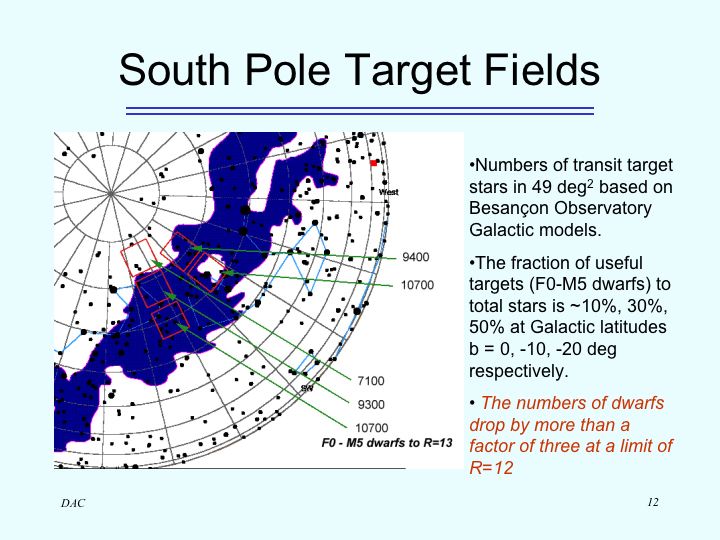
Star fields that are good for a wide field planet search
contain the largest number of bright Sun-like stars,
for our purposes F, G, and K dwarfs. The selection of
a star field requires tradeoffs of many factors: we
want to maximize the number of dwarf stars, maximize
the average star brightness, minimize the average star
size (that is, K & M stars are better than A &
F stars), minimize the number of giant stars (too large
to see a planet transit), and minimize the number of
background stars (cause confusion and photometric errors).
|
Our first field, for observations starting in May 2004, will
be centered on the star HD 84416 in the constellation Carina.
Site Selection
We have deployed our system at the South Pole. This site
offers the best combination of logistical support and weather
currently available in Antarctica. Additionally, the position
of the plane of the Milky Way at the Pole allows for observations
of rich star fields to be carried out through a constant amount
of atmosphere. Because the stars do not rise and set, the
noise caused by varying atmospheric extinction is minimized.
Perhaps the most important advantage to observing from Antarctica
is the three month winter night. In the lower latitudes, the
day/night cycle prevents continuous observation of stars and
thus significantly prolongs the observation time needed to
detect a planet's transit. With these advantages in mind,
Vulcan south hopes to be able to find Saturn-sized planets
in this winter's observations.
Additional Information
There was a description of our project published in the May
2004 issue of Astronomy Now, and two web articles: Antarctic
Astronomy: Exoplanet Hunt Moves Way Down Under at
SPACE.com, and Planet
Hunter's Paradise in the SETI
Observer. In addition, an article appeared in the SETI
Institute News (2nd Quarter 2003).
|